
The last plaster cast house in a city that once had many, still pouring history one thin layer at a time.
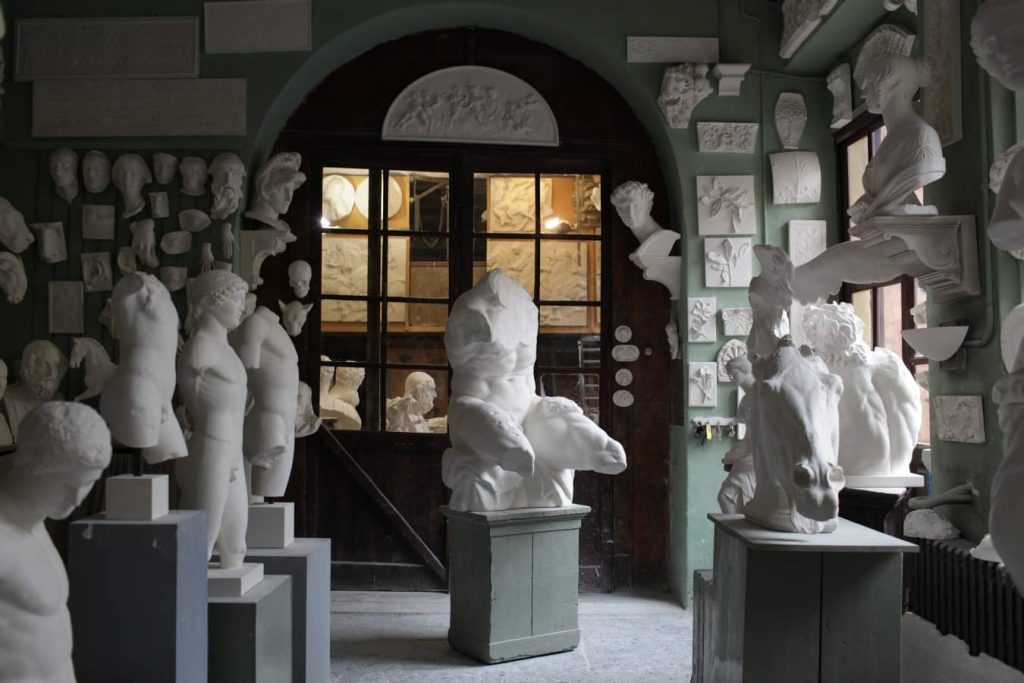
White is the hardest colour to get right. Plaster does it without trying. In a former stable off Viale Montello in Milan, two rooms hold the most persuasive case for the colour that anyone has assembled: gods, emperors, athletes, angels and anatomy lessons, all in the same chalky white, all lit by whatever light makes it through the old glass doors.
This is Fumagalli and Dossi, the largest gipsoteca in Italy and the last survivor of a Milanese trade that ran for two centuries. The word joins the Greek for plaster to the Greek for repository, which tells you the whole idea. A gipsoteca is a library of shapes. The trade grew out of the neoclassical appetite for owning Greek, Roman and renaissance masterpieces, back when very few people could afford the marble and a good plaster copy solved the problem.
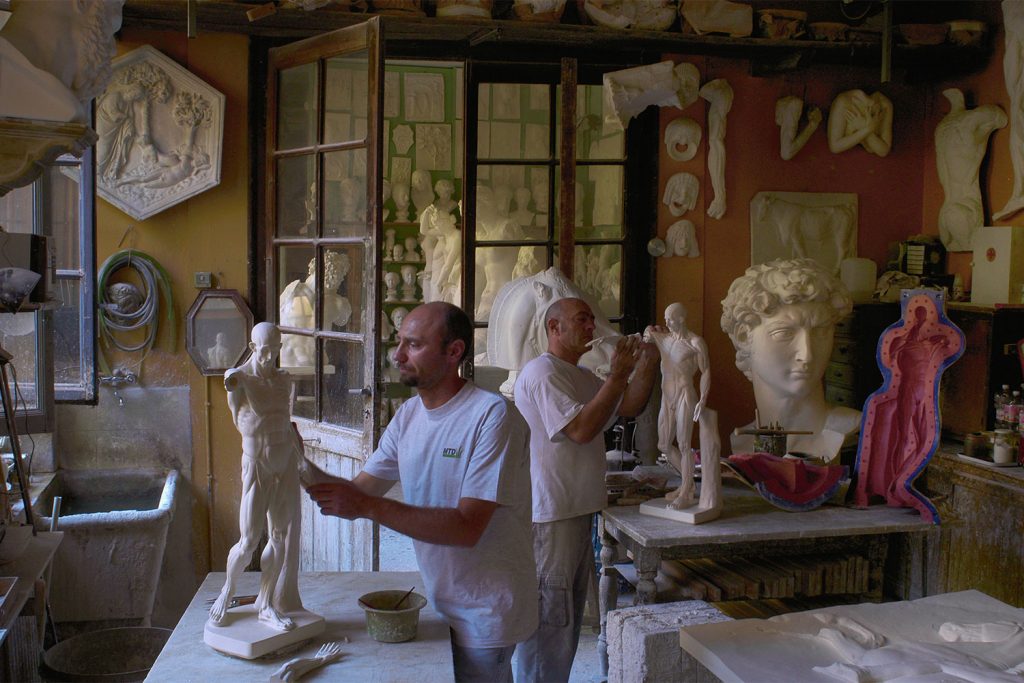
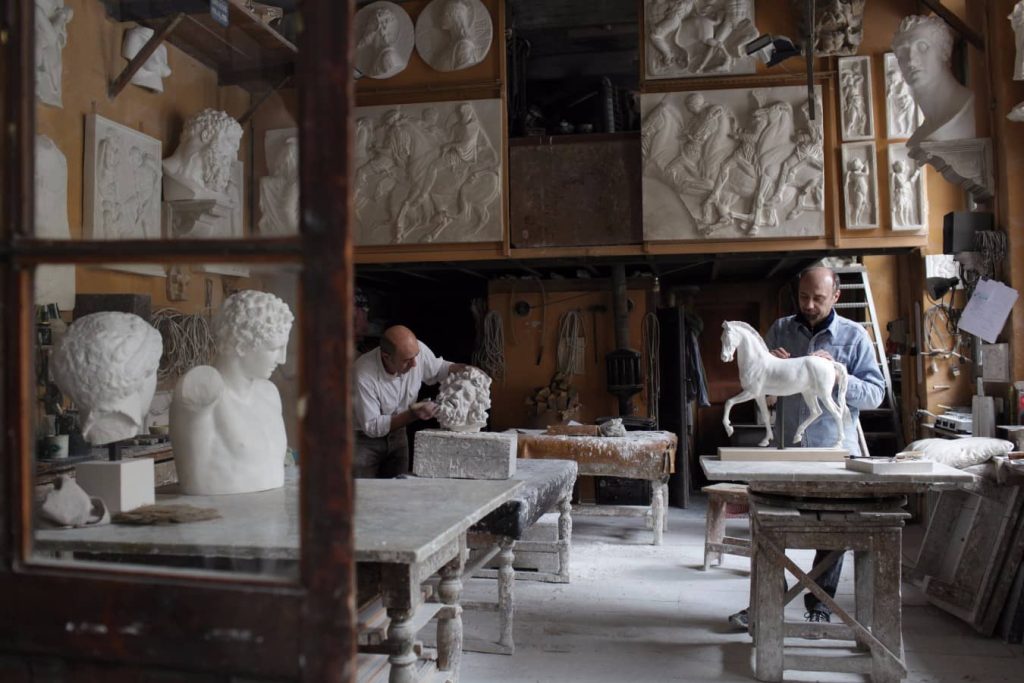
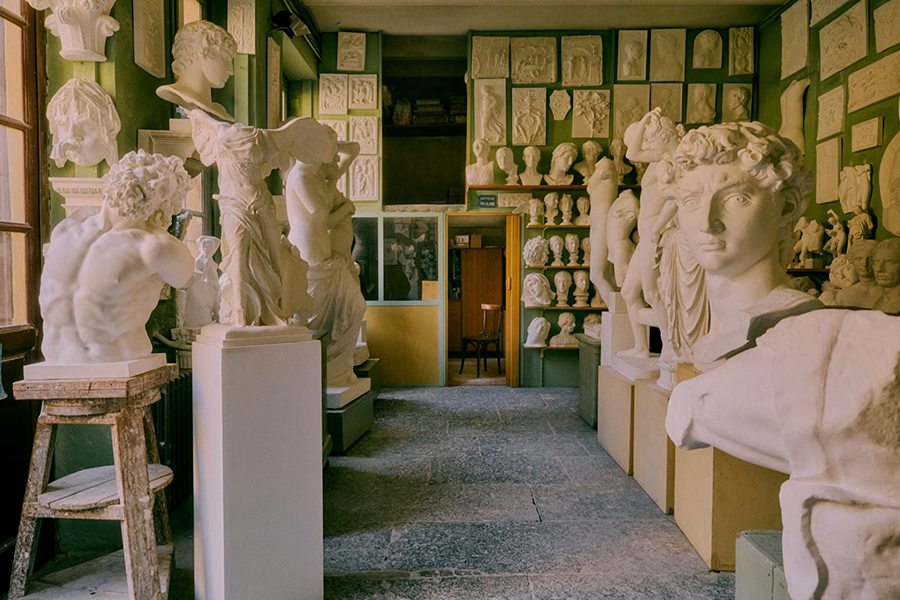
The two rooms behave like two different moods. The front one is a showroom painted a soft eau de nil green, and against it the casts turn cool and gallery-like. The back one is dustier, crowded with tools, its ochre walls hung with friezes, and the same white goes warm and workshop-honest. It is a lesson in how much a wall colour can do to a single material, and anyone who styles interiors should stand in both rooms before choosing a paint.
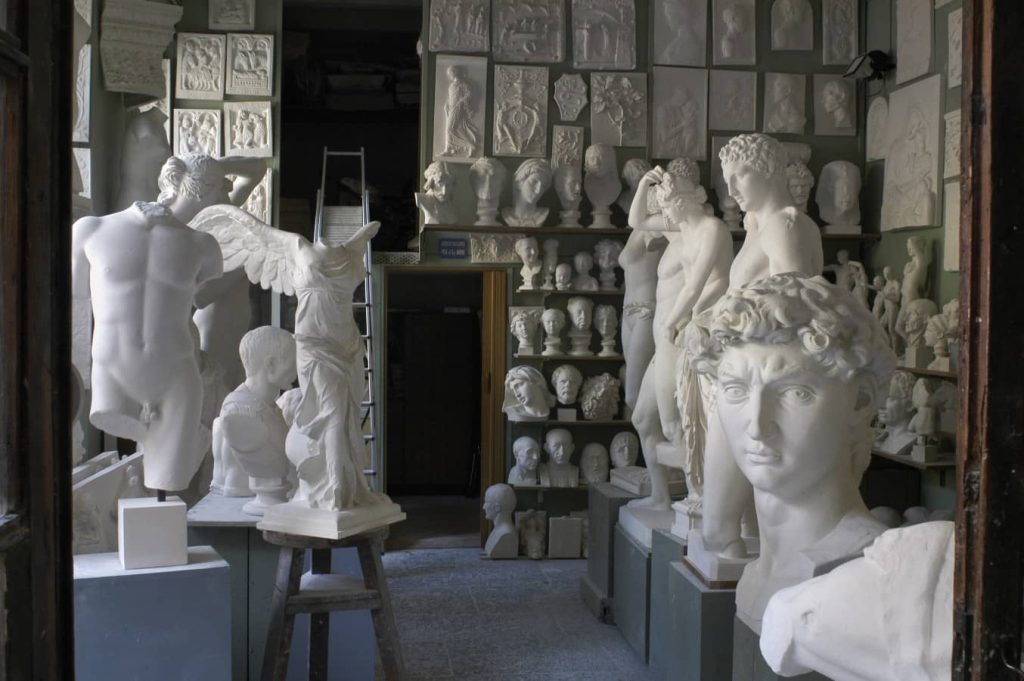
The inventory runs from the famous to the strangely intimate. There are heads of Achilles, Niobe and Nike, the long, upright body of the Strangford Apollo from the British Museum, and the birth of Aphrodite from the Ludovisi Throne, a marble relief carved around 460 BC and now in Rome. Baroque and neoclassical pieces come from the Galleria Borghese, and much of the Greek and Roman antique material from the National Archaeological Museum of Naples. Then the register shifts. Half a dozen hands sit on one shelf in different gestures. A single foot hangs from a heavy chain. Eyes the size of palms float in their own plaster discs, brows carefully drawn, each one an object in its own right.
What makes the collection impossible to repeat is its age. Most of it was cast in the second half of the nineteenth century or the first years of the twentieth, directly from works in museums. Museums stopped granting that kind of access a long time ago. Nobody can rebuild this catalogue today, and Roberto Fumagalli speaks about it as plain luck, part of it inherited from his father’s own master, a maestro named Bertolazzi. Only now and then does a client commission a fresh cast of one specific work. The daily job is just as much repair and replacement of old casts as it is making new ones.
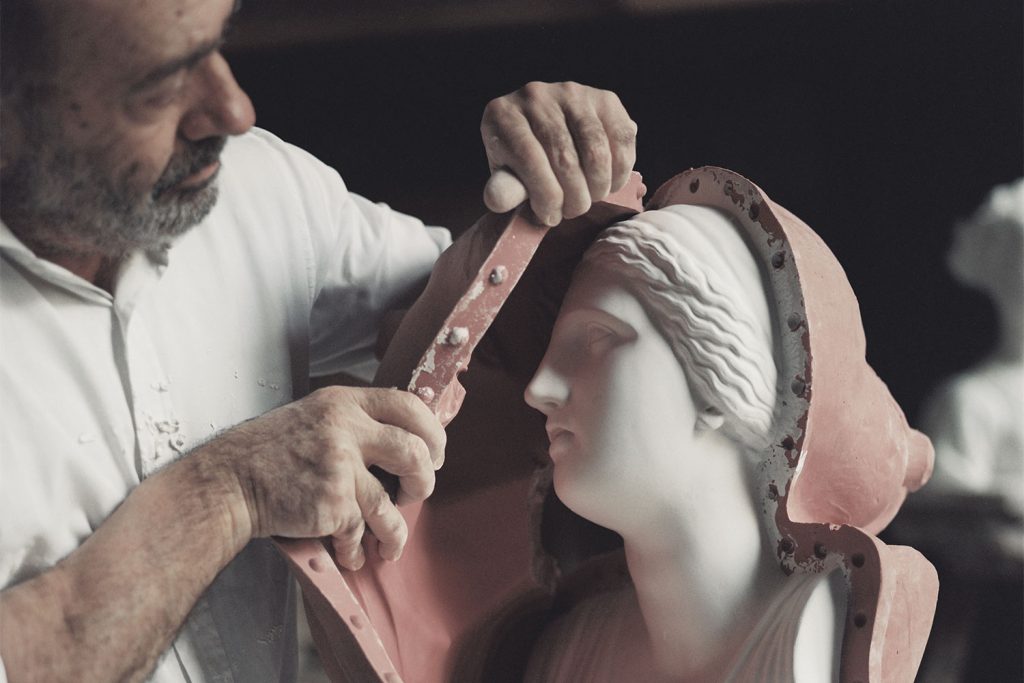
The craft stays inside one family. Agostino Fumagalli, Roberto’s father, worked in the atelier from 1946, trained by Bertolazzi and eventually took the business over. Mario Dossi arrived in 1969 at seventeen, and in 1974 he and Agostino made it official as Fumagalli and Dossi. Roberto came up as an apprentice and stepped into the partnership when his father retired. He is also Dossi’s nephew, nine years younger than his partner, because Dossi’s sister married Agostino somewhere along the way.
The method has barely changed. A layer of rubber, never more than a centimetre thick, goes over the original. A thinner layer of resin follows and gets split into two halves, and the rubber is seated precisely back inside it. Plaster is applied to the inside, sometimes with a second layer reinforced with jute, then coat after coat, each one left to dry before the next. A life-size bust takes a few hours. A full statue takes a few days. Even then the piece is not finished. A faint seam still runs along each cast, and only a hand can finish it.
The people who buy have changed. Artists once came for casts to model bronzes over, and that trade has thinned. Art schools remain the biggest customer, though orders are down from a few years ago, partly because of budgets and partly because students now work so much in the digital realm. Design and fashion houses have stepped in, buying or renting sculptures for shoots and shows. The clients the partners enjoy most are the devotees: architects, interior designers and collectors. There are more of them than in the seventies and eighties, though fewer than in the booming nineties, when the lira was still around and money was less of a worry.
A plaster head on a plinth is one of the oldest moves in interior design, and it still works because the material is so forgiving. It is matte, it softens a hard room, and it turns every shadow into a drawing. Buying one here means the face comes with a pedigree: cast in Milan, by hand, from a catalogue that the world can no longer make again.